Vismia baccifera es una planta de la Amazonía que un grupo de investigadores españoles ha estudiado frente a las células del cáncer de hígado, con resultados interesantes en el laboratorio.
This plant has traditionally been used by indigenous communities of the area for its medicinal properties. Its uses include the treatment of inflammatory processes and of certain problems relating to the urinary tract and the skin.
Researchers at the Faculty of Medicine of the University of the Basque Country decided to study this plant because earlier research had indicated that it showed significant activity against tumour cells.
The results of the research were published in the scientific journal Heliyon. To carry out the study, the researchers prepared an extract from the leaves of Vismia baccifera following a procedure similar to that traditionally used by indigenous communities: a preparation in the form of an infusion.
What happened to the cancer cells?
The researchers brought this extract into contact, in the laboratory, with liver cancer cells. In other words, the study was carried out in vitro, outside a human organism.
The results showed that the extract caused changes in the tumour cells that prevented them from continuing to reproduce and ultimately caused their death.
The researchers also studied what happened when the extract was applied to liver cells that were not cancerous. The aim was to check whether the treatment also affected healthy cells.
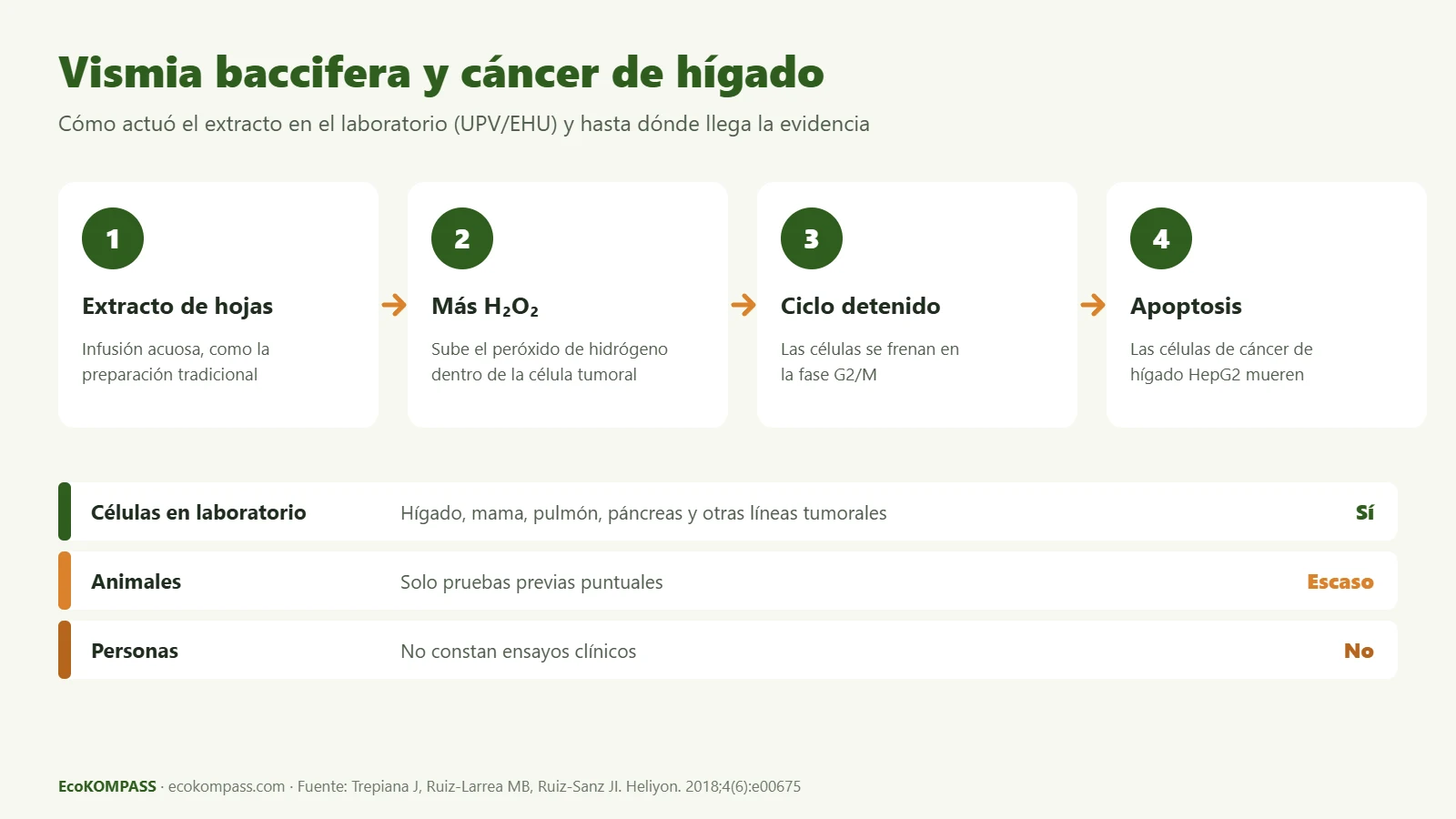
How might the plant act?
During the study they observed that the extract caused an increase in so-called free radicals inside the cells.
Free radicals are substances that can produce various changes inside cells. In this case, the increase observed was related to the loss of the cancer cells' ability to keep multiplying and to their subsequent death.
One of the aspects the researchers observed during their experiments was that the extract appeared to affect mainly the tumour cells, while the normal liver cells used in the tests were much less affected.
Earlier tests were also carried out using rat livers.
Does this mean the plant is already a treatment for cancer?
Unfortunately not. The results are experimental and, although encouraging, they constitute a first stage of research.
The work carried out with Vismia baccifera showed interesting results in the laboratory, but further research and testing would still be needed to determine whether these effects could one day be used as part of a treatment for liver cancer.
The researcher Jenifer Trepiana, who took part in the study, proposed continuing to investigate this plant with the aim of moving towards the development of a possible treatment.
Vismia baccifera, estudio a estudio
According to work published in 2018 in the scientific journal Heliyon by Jenifer Trepiana, M. Begoña Ruiz-Larrea and José Ignacio Ruiz-Sanz, of the Department of Physiology of the Faculty of Medicine and Nursing of the UPV/EHU. (PubMed), the researchers studied an aqueous extract of the leaves of Vismia baccifera and observed that it produced a cytotoxic effect on human HepG2 liver cancer cells under laboratory conditions.
What was especially interesting in the study was the mechanism they identified:
- The extract caused an increase in hydrogen peroxide (H₂O₂) inside the tumour cells.
- This increase in oxidising species was related to cell cycle arrest.
- As a consequence, the tumour cells stopped proliferating and suffered a loss of viability.
- In the experiments carried out, the extract showed much lower toxicity on non-transformed human cells used for comparison. (PubMed)
It is important to make one thing clear: they did not discover that the plant cures cancer. What they demonstrated was antitumour activity in vitro, that is, in cells cultured in the laboratory. The researchers themselves pointed out that it was still necessary to study what would happen in animal models and, subsequently, in human beings. (EiTB)
There is one particularly striking detail. The UPV/EHU group had already analysed various plants from the Amazon and had observed that Vismia baccifera showed especially high activity against liver cancer cells. That is why they decided to look into it more deeply. (Cadena SER)
In addition, the plant already had a history of traditional use by indigenous peoples of the Amazon for various problems, including inflammatory processes and certain conditions of the skin and urinary tract. The researchers used precisely an aqueous extract of the leaves prepared by infusion, following the traditional type of preparation. (Cadena SER)
No es el primer estudio sobre Vismia baccifera
In 2003, a paper published in Journal of Natural Products had studied Vismia baccifera together with other species of the genus Vismia. The researchers isolated various compounds, including ferruginin C, ferruginins A and B, vismin, harunganin and several vismiones, some of which showed cytotoxic activity against different human cancer cell lines. (PubMed)
Therefore, the Spanish work of 2018 was not the initial discovery that Vismia baccifera contains substances with biological activity. Its fundamental contribution was to investigate in greater depth how an aqueous extract of its leaves could affect liver cancer cells and the role of hydrogen peroxide in that effect. (PubMed)
Original scientific article
La fuente principal de este artículo es:
Trepiana J., Ruiz-Larrea M.B. and Ruiz-Sanz J.I. (2018).
Unraveling the in vitro antitumor activity of Vismia baccifera against HepG2: role of hydrogen peroxide.
Heliyon, 4(6), e00675.
DOI: 10.1016/j.heliyon.2018.e00675. (PubMed)
And here is the full text of the article hosted by the UPV/EHU repository: (Addi)
Vismia baccifera: del titular al resultado real
We may have read somewhere something like «Spanish scientists discover that this plant kills cancer»; the claim has a real scientific basis, but it is greatly oversimplified.
Dicho con precisión:
A team of researchers from the University of the Basque Country studied an aqueous extract of Vismia baccifera and observed anti-tumour activity against human HepG2 liver cancer cells in the laboratory, identifying a significant role for hydrogen peroxide in the mechanism.
That is quite different from claiming that the plant is a treatment for cancer in people.
According to the available studies, we must make an important distinction: The anticancer effects of Vismia baccifera have been observed mainly in cells cultured in the laboratory. Esto quiere decir que no se ha encontrado evidencia clínica que demuestre que la planta trate o cure cáncer en personas de forma natural.
| Type of cancer | Model studied | Result observed | Evidence |
| Hepatocarcinoma (liver) | Human HepG2 | Strong cytotoxic effect, cell cycle arrest and apoptosis | Direct |
| Hepatocarcinoma | Rat McA-RH7777 | Cytotoxicity at high concentrations | Preclinical |
| Breast cancer | MCF-7 / SKBr3 and other lines | Cytotoxic activity of extracts/oils | Preclinical |
| Lung cancer | NCI-H292 and lines used in 2003 | Cytotoxic activity of certain compounds | Preclinical |
| Prostate cancer | PC3 | Reduced viability with sesamin/extracts | Preclinical |
| Ovarian cancer | SK-OV-3 | More modest cytotoxic activity with sesamin | Preclinical |
| Cervical cancer | HeLa | Cytotoxic activity of extracts has been studied | Preclinical |
| Pancreatic cancer | PANC-1 | Cytotoxic activity of the essential oil | Preclinical |
| Central nervous system cancer | Human tumour cell lines | Active compounds were identified | Preclinical |
1. The most interesting result: liver cancer
This is where the research by the University of the Basque Country is especially interesting.
In human HepG2cells, an aqueous extract of the leaves produced a loss of viability that depended on concentration and time. In an earlier study, the researchers observed up to approximately 95% loss of viability at 150 µg/mL after 24–48 hours. (PubMed Central (PMC))
They subsequently studied why this happened.
They found several phenomena:
- an increase in reactive oxygen species;
- a particularly significant accumulation of hydrogen peroxide (H₂O₂);
- a decrease in glutathione;
- alteration of antioxidant defences;
- cell cycle arrest at G2/M;
- activation of caspase-3;
- an increase in pro-apoptotic proteins such as Bax;
- a decrease in anti-apoptotic proteins such as Bcl-2;
- signals consistent with DNA damage, including phosphorylation of γH2AX. (PubMed)
A particularly interesting finding is that catalase, an enzyme that eliminates H₂O₂, prevented much of the toxicity produced by the extract. This led the researchers to conclude that hydrogen peroxide plays a central role in the cytotoxic effect observed. (PubMed Central (PMC))
Furthermore, in that experiment the extract showed no appreciable toxicity on the non-transformed human hepatocyte line HH4 up to 150 µg/mL. This does not mean that it is safe in humans, but it does constitute an interesting finding of selectivity in that experimental model. (PubMed Central (PMC))
2. Breast, lung and central nervous system cancer
According to a considerably earlier study published in 2003 in Journal of Natural Products, the researchers carried out bioassay-guided fractionation of methanolic extracts of Vismia baccifera and two other species of the genus (V. jefensis y V. macrophylla).
They found several compounds with cytotoxic activity against human breast, lung and central nervous system cancer cell lines.
Among them were:
- ferruginin C;
- ferruginins A and B;
- vismin;
- harunganin;
- vismione B;
- deacetylvismione H;
- deacetylvismione A.
The compounds vismione B, deacetylvismione H and deacetylvismione A were those that showed the greatest activity in that study. (ACS Publications)
There is an important caveat here: the study worked with three species of Vismia. Therefore, it would not be correct to automatically attribute all the results exclusively to V. baccifera. (PubMed)
3. Lung cancer: sesamin (present in sesame seeds)
Con respecto a esta enfermedad, también existe un estudio específico sobre sesamin isolated from Vismia baccifera var. dealbata.
Sesamin produced cytotoxic activity against the lung cancer line NCI-H292, while it showed much lower activity on a normal lung epithelial line used for comparison.
The reported IC₅₀ was approximately 1 g/L, a fairly high concentration, so this result should be interpreted with caution and does not amount to demonstrating therapeutic efficacy. (Sage Journals)
Cells were also tested from prostate (PC3) y ovary (SK-OV-3), but the activity was more modest. (Sage Journals)
4. Breast and pancreas: more recent results
In 2020, the essential oil from the leaves of Vismia baccifera was studied on:
- SKBr3 — breast cancer;
- MCF-7 — breast cancer;
- PANC-1 — pancreatic ductal adenocarcinoma.
Cytotoxic activity was observed against all three tumour lines. In addition, one of the oils from V. baccifera showed high selectivity against SKBr3 relative to human dermal fibroblasts used as non-tumour cells. (SciELO Costa Rica)
This is interesting because it indicates that the activity of V. baccifera does not appear to be limited to liver cancer, although once again we are talking about cell experiments.
Lo que sabemos de Vismia baccifera y lo que no
If we want to be rigorous, the available evidence allows us to say:
- In vitro cytotoxic activity has been demonstrated for extracts or compounds derived from Vismia baccifera against different tumour lines.
- The effect is particularly well studied in HepG2 hepatocarcinoma.
- In HepG2, even the molecular mechanism has been studied, revealing an important role for oxidative stress and particularly H₂O₂, together with cell-cycle arrest and apoptosis. (PubMed)
- Compounds from the plant have been found with activity against breast, lung and central nervous system cancer lines. (PubMed)
- There are also experimental results against prostate, ovarian, cervical and pancreatic cancer. (SciELO Costa Rica)
But:
- This does not mean that Vismia baccifera cures any of these cancers.
- No constan ensayos clínicos que demuestren eficacia antitumoral de la planta en pacientes.
- Nor can we assume that an infusion of the plant has the same effect as the extracts, fractions, oils or isolated molecules used in the experiments.
And there is one especially important detail: the mechanism observed in HepG2 is rather peculiar. It is not simply a matter of the plant containing an antioxidant that “protects” against cancer. In the tumour cells studied, precisely the opposite seems to occur: La acumulación de especies reactivas de oxígeno, especialmente H₂O₂, contribuye a desencadenar la apoptosis, es decir, la muerte programada de las células tumorales. (PubMed)
Si te interesan otros enfoques de investigación contra el cáncer, puedes leer también sobre la cancer reversion o sobre los hábitos que de verdad reducen el riesgo de cáncer.
Importante: Vismia baccifera no es un tratamiento contra el cáncer. Si tienes un diagnóstico de cáncer, no sustituyas ni combines tu tratamiento con preparados de plantas sin consultarlo con tu oncólogo, porque algunas pueden interferir con los fármacos. Este artículo es divulgativo y no sustituye la valoración de un profesional sanitario.
Conclusion
Un equipo de investigadores de la Universidad del País Vasco estudió un extracto acuoso de Vismia baccifera y observó actividad antitumoral frente a células humanas de cáncer hepático HepG2 en el laboratorio, con un papel relevante del peróxido de hidrógeno en el mecanismo. Es un punto de partida prometedor, pero todavía lejos de un tratamiento: faltan estudios en animales y, sobre todo, ensayos clínicos en personas.